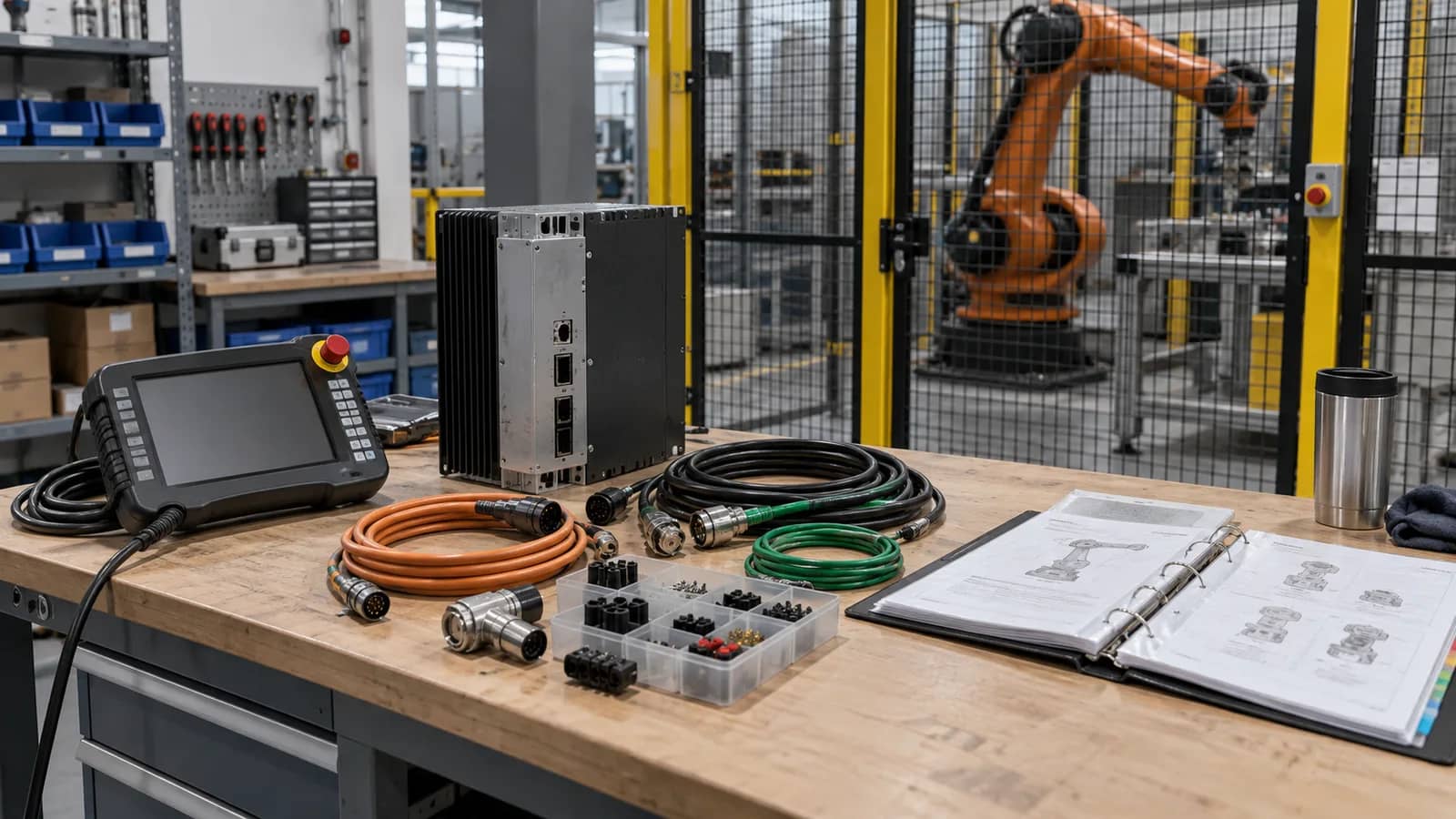
A five-input criticality model for each spare
Use the inputs to choose a recovery route. Avoid a numerical score that hides an unresolved safety or compatibility issue.
- Failure effect
- Safe-use, quality or full-cell stop; affected machines and parts.
- Recovery boundary
- Tolerable interruption and approved workaround, if any.
- Supply evidence
- Exact part, location, quote date, availability and confirmed delivery route.
- Restore capability
- Tools, skills, backup, license, configuration and required revalidation.
- Ownership
- Who stocks, orders, installs, returns and replenishes the part.
Compare tolerable interruption with detection + diagnosis + approval + supply + replacement + restoration + validation time. This is a planning equation, not a reliability prediction. Unknown availability remains an open input; it must not be entered as zero delay.
Build the list from the installed cell, not a generic robot kit
A spare list should cover the robot, controller, EOAT, fixtures, sensors, process equipment, safety devices, power supplies and connected peripherals within the purchased scope. Tie each item to a station, assembly drawing and installed BOM revision. Record manufacturer, part number, revision, robot/controller model and serial applicability. Add a nameplate photo and connector details where identity is uncertain. KUKA's ordering guidance illustrates the value of system, station, part and drawing references; those identifiers are useful buyer inputs regardless of the selected supply route.
Do not treat a physically similar connector or a shared marketing name as proof of interchangeability. A replacement can depend on electrical characteristics, firmware, safety configuration, calibration or licenses. Keep approved alternatives with their evidence and validation requirements. For controller version checks, use the separate compatibility guide; this plan uses those checks to decide stocking and recovery responsibility rather than duplicating an integration specification.
Further reading: KUKA — Spare parts identification and ordering inputs ↗
Three recovery tiers, chosen from verified inputs
No approved workaround; evaluate local stock, restore package and competent replacement capacity.
Shared stock, exchange or repair only when verified end-to-end recovery fits the interruption boundary.
Routine supply or scheduled maintenance with condition checks and replenishment ownership.
Separate item class from production criticality
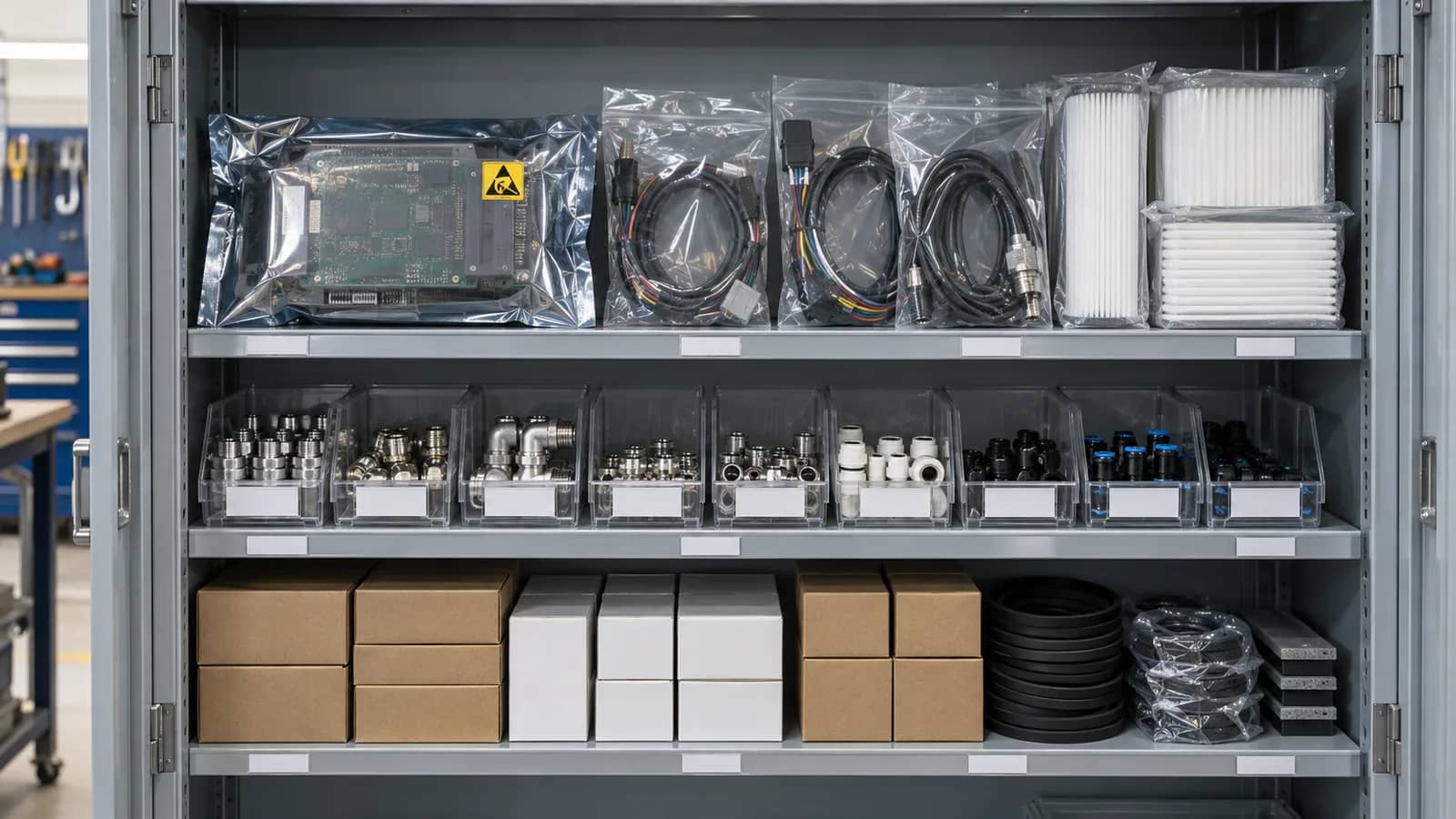
Consumables are used by the process; wear parts are replaced through maintenance; repairable modules have a return or workshop route; capital spares can require substantial investment and specific storage. These classes do not automatically determine priority. A small sensing component can stop a cell, while an expensive assembly may have an approved alternative. For each failure, ask whether safe use, quality or output is affected, how it is detected, whether redundancy is real and which qualified team can restore the application.
Use three decision tiers. Tier A has no approved workaround and an unacceptable interruption if the verified route fails: evaluate local or dedicated stock and a tested restoration package. Tier B can use a documented shared-stock, exchange or repair route within the agreed interruption: verify access and transport rather than assuming another site can release its part. Tier C can follow routine replenishment or planned maintenance. These are buyer planning tiers, not manufacturer failure probabilities or promises of availability.
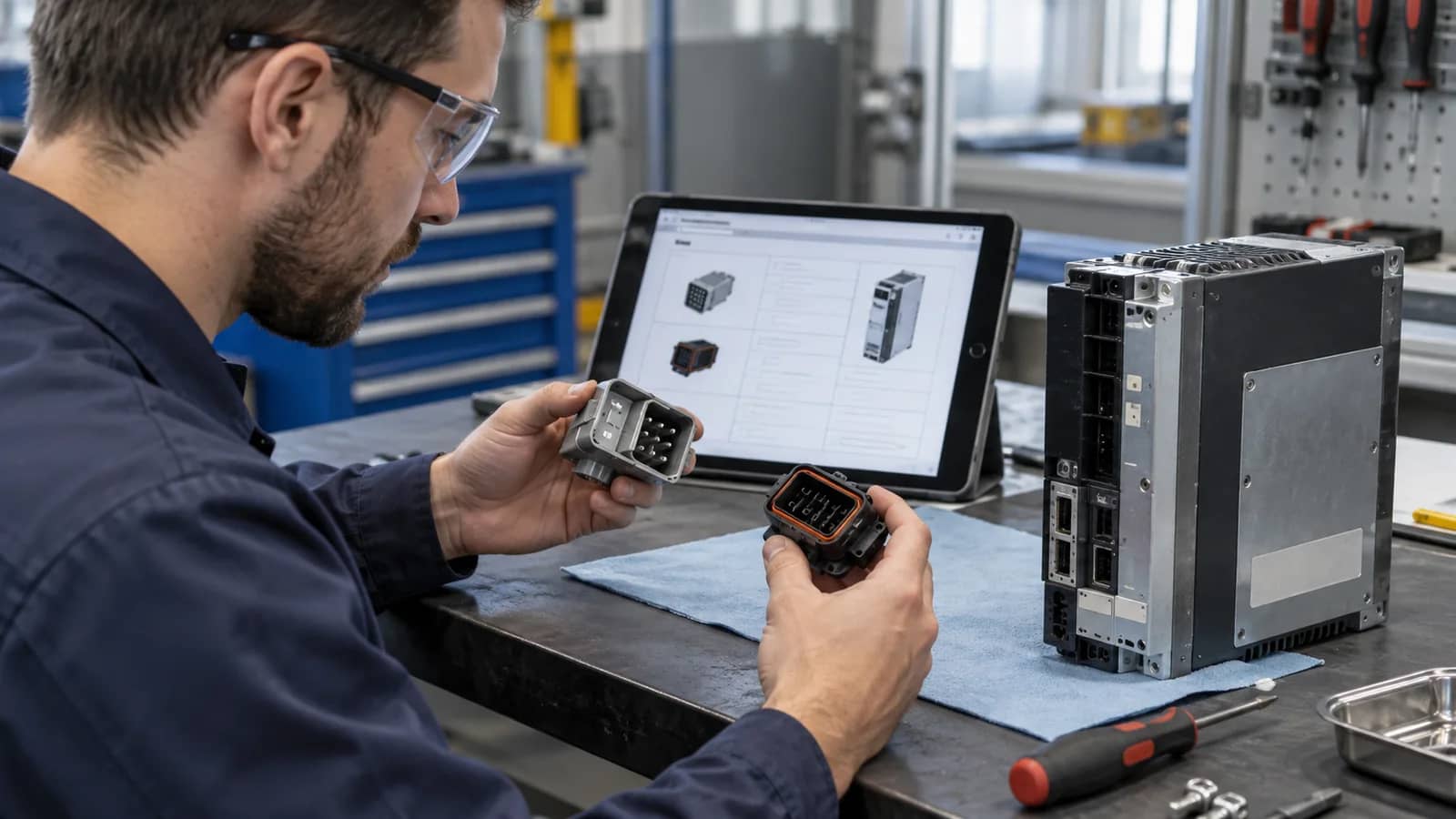
Specify the recovery route and stock ownership
A stock decision needs a location, custodian, issue authorization, inventory record and replenishment trigger. Determine storage conditions from the specific component instructions, including any shelf-life, ESD, moisture or periodic checks. Separate physical presence from usable availability: a stored controller module can still be wrong-version, reserved elsewhere or missing its configuration. Use documented installed-base consumption and confirmed replenishment inputs when available; when they are absent, record the decision as provisional and assign a review date rather than inventing component life.
New supply, advance exchange and repair of the same unit have different commercial and recovery boundaries. Ask who authorizes diagnosis, sends the replacement, pays freight, returns the failed core, handles deposits and decides warranty eligibility. FANUC's public support material distinguishes technical support, parts and repair; ABB's lifecycle material also separates repair from modernization. Treat those service concepts as questions for your supplier, not as TubeFrame coverage. Confirm each part's route, destination and terms in writing.
Further reading: FANUC America — Parts, repair and product support ↗
A spare becomes useful through five decisions
Installed part and revision
Failure effect and workaround
Supply, repair and restore route
Stock, procurement and replacement owners
Changes, consumption and lifecycle notices
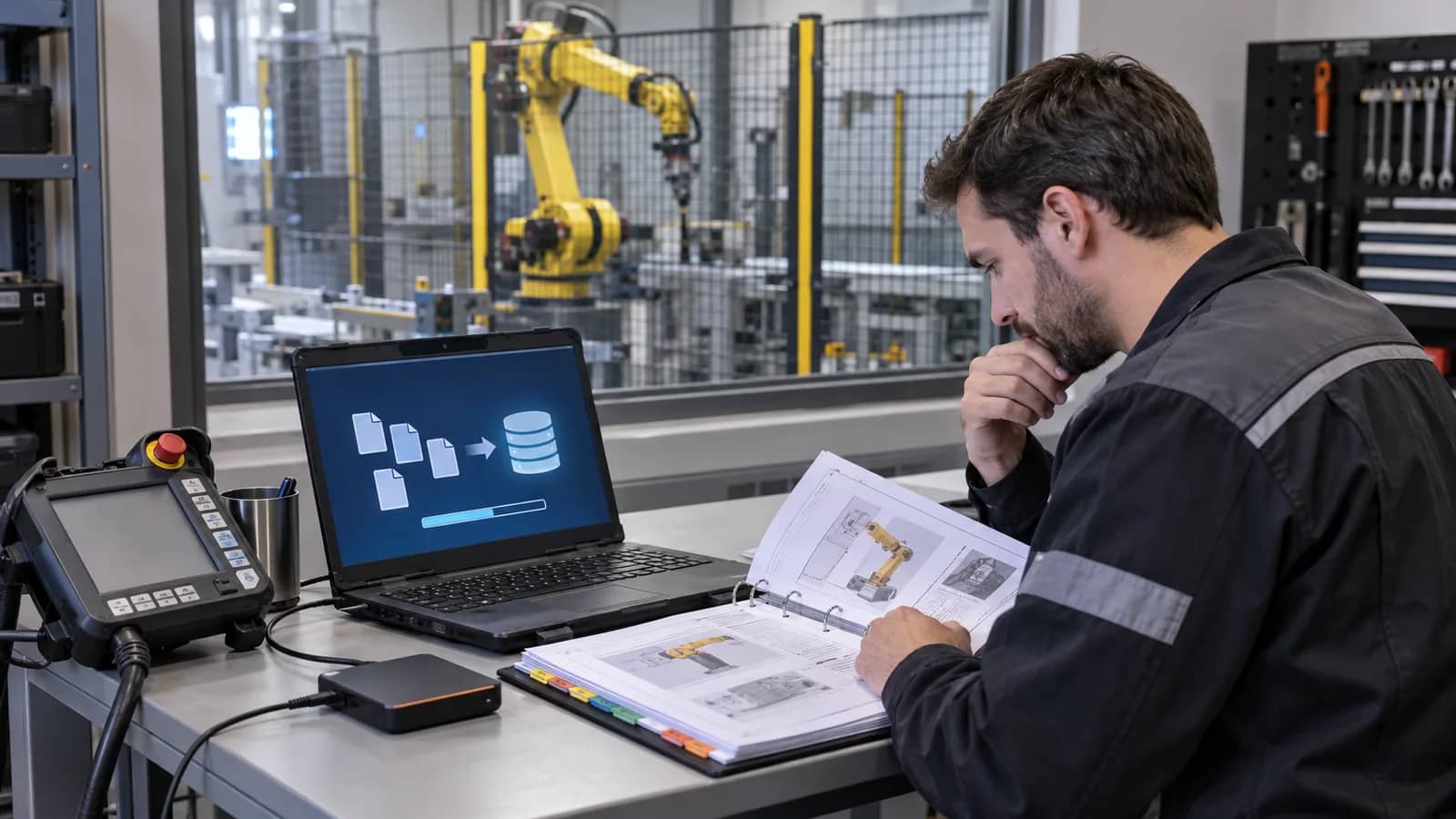
Plan software recovery and obsolescence with the hardware
Maintain a controlled manifest of robot programs, PLC/HMI projects, safety settings, calibration data, recipes, network configuration and software versions. Specify backup location, update trigger, access rights, restoration tools and license transfer or activation requirements. Test the agreed restoration procedure in a controlled environment. After replacement, assess the required functional, process and safety verification before release. A replacement drive, controller or sensor is not automatically production-ready when it is powered on.
Ask the manufacturer or responsible supplier for the current lifecycle status, last-order notice route, supported successors and repair feasibility of each critical part. ABB publishes lifecycle assessment and controller/software upgrade concepts, but the status and pathway still need exact equipment confirmation. A successor may trigger interface, software or safety changes; record its engineering work and acceptance evidence as a project. Review the spare plan after configuration changes, consumption, failures or supplier notices, and link the released list to the SAT handover pack.
Further reading: ABB — Robot lifecycle assessment and modernization ↗
Copyable spare parts and recovery responsibility matrix
Add installed quantity, stock quantity decision, criticality tier, confirmed lead-time source, supplier quote date and review date. Leave unknown values open; this worksheet does not prescribe a universal stocking quantity.
Copy the rows into your RFQ or investment worksheet.
| Plan line | Identity / evidence input | Recovery / stock decision | Owner and closure record |
|---|---|---|---|
| Installed baseline | BOM, drawing, serial and firmware | Approved exact or validated substitute | Engineering; released manifest |
| Consumables | Process specification and real use | Routine supply and storage conditions | Operations; consumption and reorder record |
| Wear parts | Manufacturer maintenance instructions | Planned replacement and stock review | Maintenance; inspection history |
| Repairable modules | Model, diagnosis and repair eligibility | Same-unit repair or confirmed exchange | Service/procurement; return authorization |
| Critical capital spares | Failure impact and verified recovery time | Dedicated, pooled or supplier-held stock | Plant/procurement; approved risk decision |
| EOAT and process parts | Tool revision, sensor and fitting identity | Restore gripping/process and verify quality | Process/maintenance; verification result |
| Stock location | Usable condition and access rights | Issue, reserve and transport procedure | Store custodian; inventory record |
| Replenishment | Usage and supplier confirmation | Trigger, approval, purchase and receipt | Procurement; order and receipt trail |
| Backups and licenses | Program, parameters and entitlement | Controlled restore and activation path | Controls/IT; restore evidence |
| Revision changes | Compatibility evidence and release | Assess installed and stored parts together | Engineering; change approval |
| Warranty and returns | Written terms for exact item/route | Diagnosis, core, freight and deposits | Contract/service owners; claim decision |
| Obsolescence and upgrade | Lifecycle notice and supported successor | Last buy, repair or engineered migration | Asset/engineering owners; revised plan |
Frequently asked questions
Which robot spare parts should be stocked locally?
Evaluate items with no approved workaround whose verified recovery route exceeds the buyer's tolerable interruption. Confirm exact applicability, storage, replacement skills and restoration before approving stock.
Is a spare controller enough to recover a cell?
Not necessarily. Correct hardware may still require matching software, licenses, programs, safety settings, calibration, network parameters and authorized validation before production release.
How do repair and exchange routes differ?
Repair returns the same unit after diagnosis and approval. An exchange route supplies a replacement under agreed return conditions. Confirm stock, timing, core return, freight, deposits and terms for the exact part.
Does TubeFrame publish standard spare-parts lead times?
No universal public lead time is available. Supply, compatibility, service responsibility and terms are confirmed for the exact robot, controller, part, destination and project scope.
Sources for the planning framework
Make the parts request specific to your installed system
Send robot and controller models, serial references, part numbers, nameplate photos, fault context, quantity and destination. TubeFrame can review sourcing inputs and coordinate a project-specific parts and service boundary.
Request robot parts scope review ↗