
Five records that make SAT executable
Give every test an identity and a release decision. A checked box without a result cannot explain what was accepted.
- Baseline
- Robot, tooling, controller, PLC, HMI and safety configuration revisions.
- Preconditions
- Site readiness, approved test method, competent personnel and controlled access.
- Acceptance criteria
- Contract requirement, test parts, operating conditions and expected result.
- Evidence
- Measured result, record reference, date, operator and witness.
- Disposition
- Accepted, hold or agreed restricted release; owner, due date and re-test.
A commercial signature cannot replace unresolved safety validation. Record the exact permitted operating boundary and keep blocking issues closed to production until the responsible team verifies corrective action.
What SAT adds after FAT
Factory acceptance testing checks the agreed configuration before shipment. Site acceptance testing checks that configuration after installation, with the production site's utilities, connected machines and environmental conditions. OSHA explicitly describes SAT in this site-dependent context. Use the FAT report as a starting record: identify tests carried forward, tests to repeat and tests that could only be performed on site. Keep the FAT defect log and configuration changes attached so that a changed cable route or software revision does not silently inherit an earlier pass.
Separate installation completion, safety validation, process acceptance and production release. They answer different questions. A cell can be physically assembled while utilities remain unstable; it can execute motion while quality evidence remains incomplete. Define who approves each gate and which records are required. ISO 10218-2 covers integration and information for use across the application lifecycle; its public scope is not a substitute for the applicable project standard or a certificate of compliance.
Further reading: OSHA — Industrial Robot Systems and System Safety ↗ · ISO — ISO 10218-2:2025 integration and lifecycle scope ↗
Carry forward, repeat or add: three SAT evidence routes
Unchanged configuration; identify the original record and justify applicability.
Installation, utilities, safeguards and connected equipment affect the result.
Real material flow, production conditions, quality and handover criteria.

Confirm the site before beginning acceptance trials
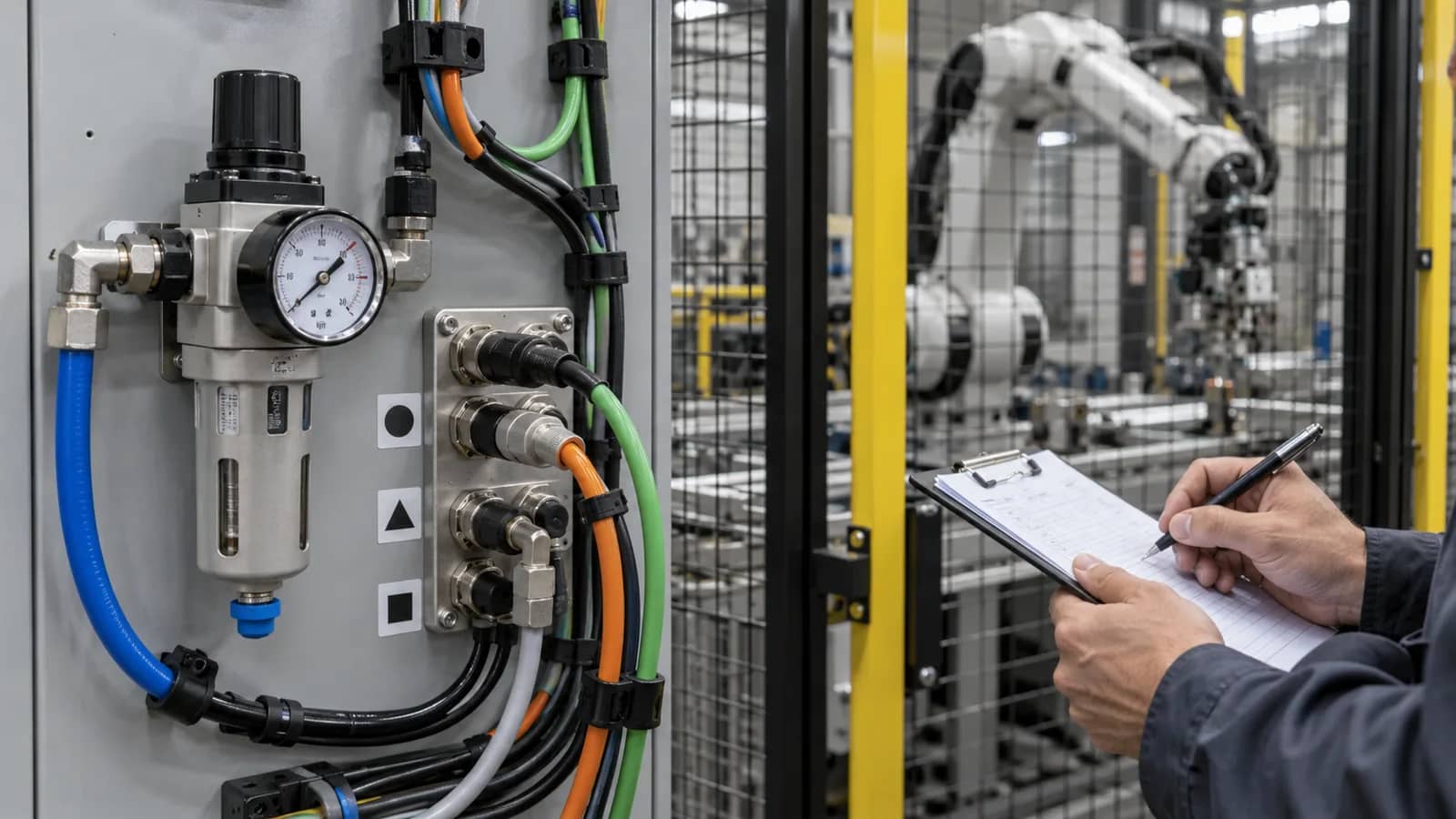
Compare delivered model and serial identities with the purchase baseline. Check transport damage, anchoring and leveling records, tooling location, peripheral equipment and installed software versions. Record utilities at the agreed connection points under the agreed operating conditions: supply characteristics, air, cooling, gases, extraction and network access where relevant. Do not use universal utility thresholds; obtain them from the installed equipment documents and project design. Assign missing facility work to its owner before it becomes a failed process test.
For each machine or conveyor interface, record signal meaning, source, destination, permissives, timeout behavior and reset ownership. Verify normal transitions and approved abnormal conditions. A network connection or illuminated ready bit is insufficient if the two devices interpret that bit differently. Record time-stamped state evidence and the corresponding PLC/robot program revision, then preserve the final interface map with the handover package.
Test safety, production and recovery as separate evidence sets
The responsible safety specialists should use the approved validation plan for the installed application, including guarding, interlocks, protective stops, emergency functions, operating modes and reset behavior. Plan tests without exposing people to hazardous motion or improvising faults. A3's September 2026 safety update highlights interactions during maintenance and troubleshooting as well as normal production. Capture the validated settings and records; any subsequent relevant change needs an assessed verification scope.
Production trials should use agreed part families, incoming variation, operators, consumables and measurement methods. Measure the full cycle, including loading, clamping, transfer, process, inspection and unloading. Define sample quantity, duration, exclusions, quality limits and handling of interruptions in the protocol rather than inventing them during the witness test. Record rejected parts and rework alongside good output. Approved recovery scenarios should verify part disposition, retained state and restart permissions after interruption; successful restart alone does not prove the interrupted part is acceptable.
Further reading: A3 — The State of Industrial Robot Safety (22 September 2026) ↗
From site readiness to signed SAT
Protocol, revisions and witnesses
Installation and utility readiness
Approved safety and interface tests
Cycle, quality and recovery evidence
Close blockers, documents and ownership
Close issues with evidence and a usable handover pack
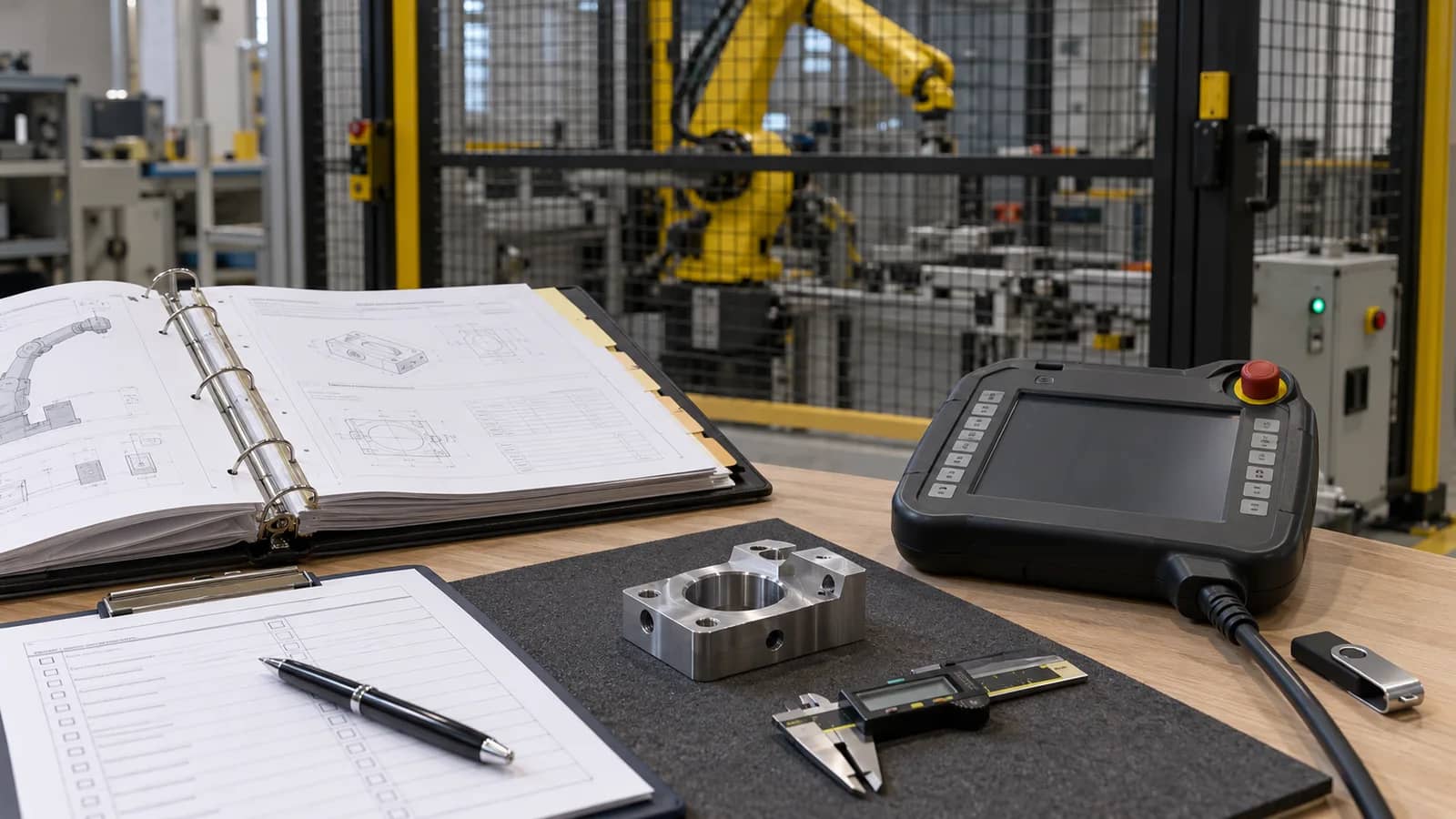
Training should identify operator, programmer and maintenance tasks, language, attendees and demonstrated competence for the agreed scope. Hand over as-built mechanical and electrical drawings, manuals, safety records, interface definitions, program manifests, parameter sets, license records and access arrangements. Check that backups can be restored using the agreed procedure in a controlled environment, with any motion-related validation managed separately. A saved file is not yet evidence of a usable recovery package.
Use an open-item register with requirement, observed deviation, operational effect, corrective action, accountable owner, date and re-test evidence. Keep safe-use blockers separate from cosmetic or documentation issues. Any agreed restricted release must identify its exact scope and approval authority; it cannot erase unresolved hazards. Link the signed SAT decision to the final configuration and service contacts so that operations inherits both the accepted system and the remaining responsibilities.
Copyable robot cell SAT evidence table
Add requirement ID, protocol revision, actual observation, evidence filename, witness, date and disposition to each row. The method column describes planning inputs; the signed project protocol sets the test and passing criteria.
Copy the rows into your RFQ or investment worksheet.
| Acceptance item | FAT record to carry | SAT method / site input | Evidence and accountable owner |
|---|---|---|---|
| Delivered configuration | BOM and serial manifest | Match installed equipment and revisions | As-built manifest; supplier and buyer |
| Installation | Approved layout and mounts | Check damage, anchoring and access | Installation record; site/integrator |
| Utilities | Equipment requirements | Record actual supply at test conditions | Utility measurements; facility owner |
| Machine interfaces | Signal and state map | Witness handshakes, permissives and timeouts | State log; controls owners |
| Safety functions | Design and validation baseline | Execute approved installed-application validation | Validation report; competent safety team |
| Operating modes | Mode and access specification | Verify selection, permissions and transitions | Mode test record; integrator/user |
| Complete cycle | FAT part and cycle conditions | Use agreed site mix and full-cycle definition | Time and interruption log; process owner |
| Quality | Drawing and process criteria | Measure samples using approved method | Traceable measurement record; quality owner |
| Abnormal recovery | Approved recovery scenarios | Verify part disposition and restart state | Recovery results; controls/process owners |
| Training | Agreed task syllabus | Demonstrate tasks with designated staff | Attendance and task evidence; user/supplier |
| Technical documents | Deliverable index | Check final as-built revisions and language | Document register; document owner |
| Backup and licenses | Program/software manifest | Controlled restore procedure and access check | Restore record; authorized controls team |
| Open items and handover | FAT issue history | Close blockers and assign remaining actions | Signed decision and owners; buyer/integrator |
Frequently asked questions
Does a passed FAT remove the need for SAT?
No. SAT verifies site utilities, installed interfaces and application conditions that may differ from the factory test. Carry forward valid FAT evidence and document what must be repeated or added.
How many cycles should SAT include?
There is no universal number. Agree duration, part mix, sample quantity, cycle definition, interruptions and quality criteria in the project protocol before testing.
Who should execute and witness SAT?
Assign the integrator, site utility owners, process and quality teams, competent safety specialists and buyer witnesses by test scope. Record execution and approval roles separately.
Can a cell be handed over with open items?
Only within an explicitly agreed release boundary with owners and closure evidence. Unresolved safe-use blockers require corrective action and verified closure before affected production use.
Sources for the planning framework
Define the site acceptance boundary before delivery
Send the application, configuration baseline, FAT record, site interfaces and acceptance requirements. TubeFrame can coordinate project inputs and delivery responsibilities for a reviewable SAT scope.
Discuss robot cell acceptance ↗