
FAT shipment decision: the minimum record
A FAT checklist becomes useful only when each result can be traced to a requirement and a shipment decision. Agree the fields below before the witness visit.
- Test basis
- Signed protocol revision, sample IDs, drawing/program versions, limits, method and named witnesses.
- Result and evidence
- Pass, fail, not run or agreed site-only for each test, with measurement or observation ID and responsible signer.
- Open-item route
- Severity, mitigation, owner, due date, re-test evidence and any explicit SAT hold point.
Do not relabel an unrun or failed requirement as passed. Release for shipment only against the signed FAT scope and an explicit disposition of every open item; site acceptance remains separate.
Freeze the FAT protocol before the witness visit
Start from the signed requirement list, not the supplier's demonstration sequence. Identify cell configuration, robot and weld-package versions, fixture drawing, program revision, approved weld criteria, representative part family, incoming tolerance and site interfaces. Agree who brings sample material, consumables and gauges, and who may witness and sign. A requirement without a method, limit and record is not yet a test.
Separate what can be proven at the supplier's facility from what depends on the buyer's building, utilities or upstream line. Mark site-only tests for SAT with an owner and planned date; do not quietly label them passed during FAT. ISO 10218-2:2025's public summary covers industrial robot-cell integration and commissioning, but it is not a substitute for a project-specific test protocol or a claim that this checklist certifies safety.
- Version-controlled specification, drawings, programs and I/O list
- Approved part samples, weld/inspection criteria and cycle definition
- Witnesses, equipment, records and FAT-versus-SAT boundary
Further reading: ISO — ISO 10218-2:2025 public summary ↗
Motion demo versus FAT evidence
Shows a path; not weld quality, repeatability or whole-cell cycle.
Shows one sample; not boundary fit-up, fault recovery or variants.
Links each agreed requirement to result, version, proof and owner.
Witness production-like welding, not a highlight reel
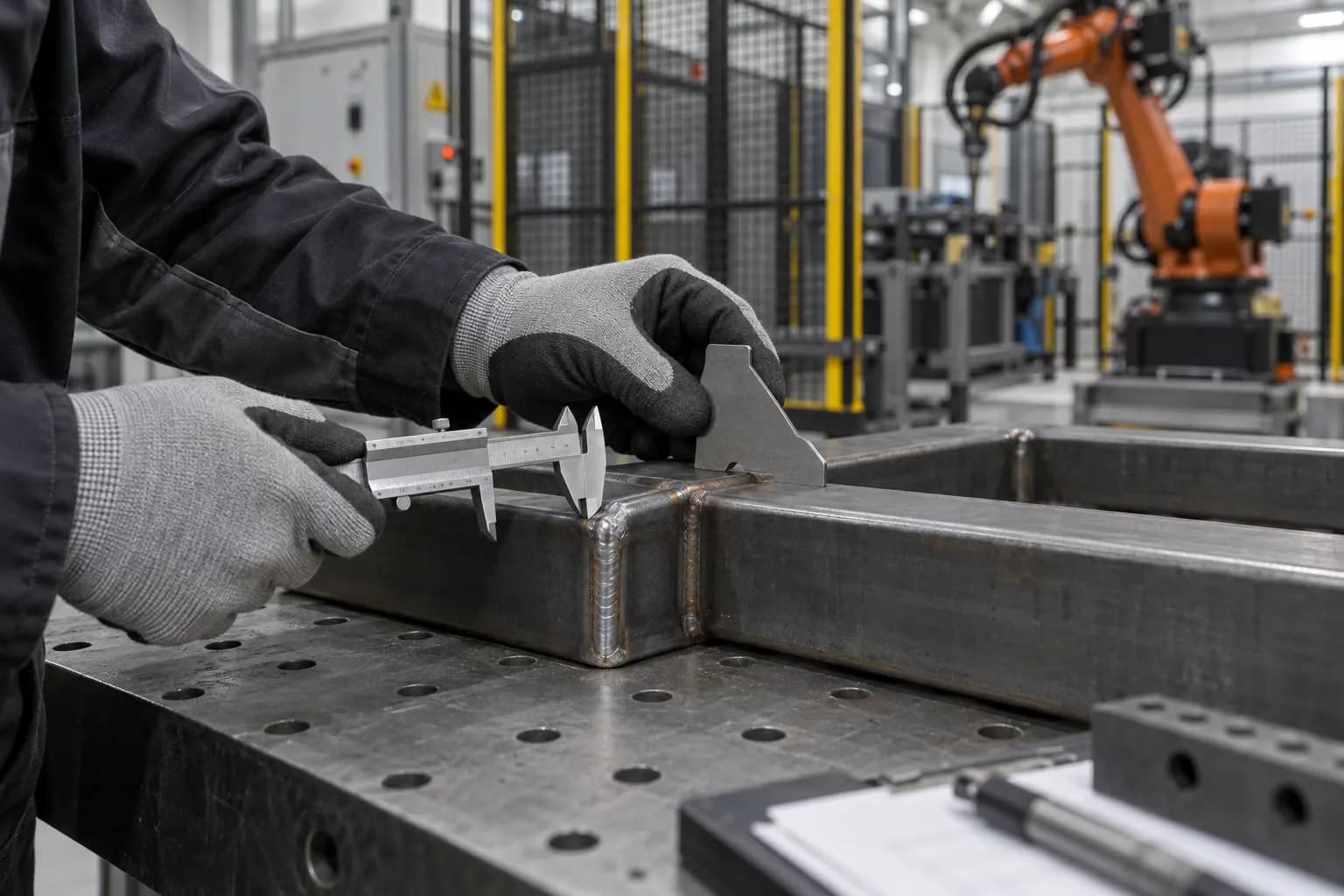
Run the agreed sequence with the specified production-like parts. Log loading, clamping, positioner movement, arc-on, cleaning, unloading, inspection and normal reset when defining full-cell cycle. Record the number of consecutive accepted parts and the exact measurement method agreed for this project; a single favorable sample cannot prove repeatability. Check part and weld traceability, fit-up at the fixture datum, torch access and the disposition of a rejected weld.
Bullitt Robotics and EVS Tech both distinguish a clean demo from acceptance under representative variation and complete-cycle conditions. This guide goes further on the buyer's release decision: every row below needs pass evidence, the responsible signer and an explicit closure path for exceptions. Do not borrow a supplier's published cycle figure as your acceptance limit.
- Witness nominal and agreed boundary samples.
- Retain weld inspection and dimension results tied to part IDs.
- Record the full cycle basis, not just robot motion or arc time.
Further reading: Bullitt Robotics — welding-cell FAT and SAT ↗ · EVS Tech — welding workstation acceptance ↗
Exercise safety functions and abnormal recovery
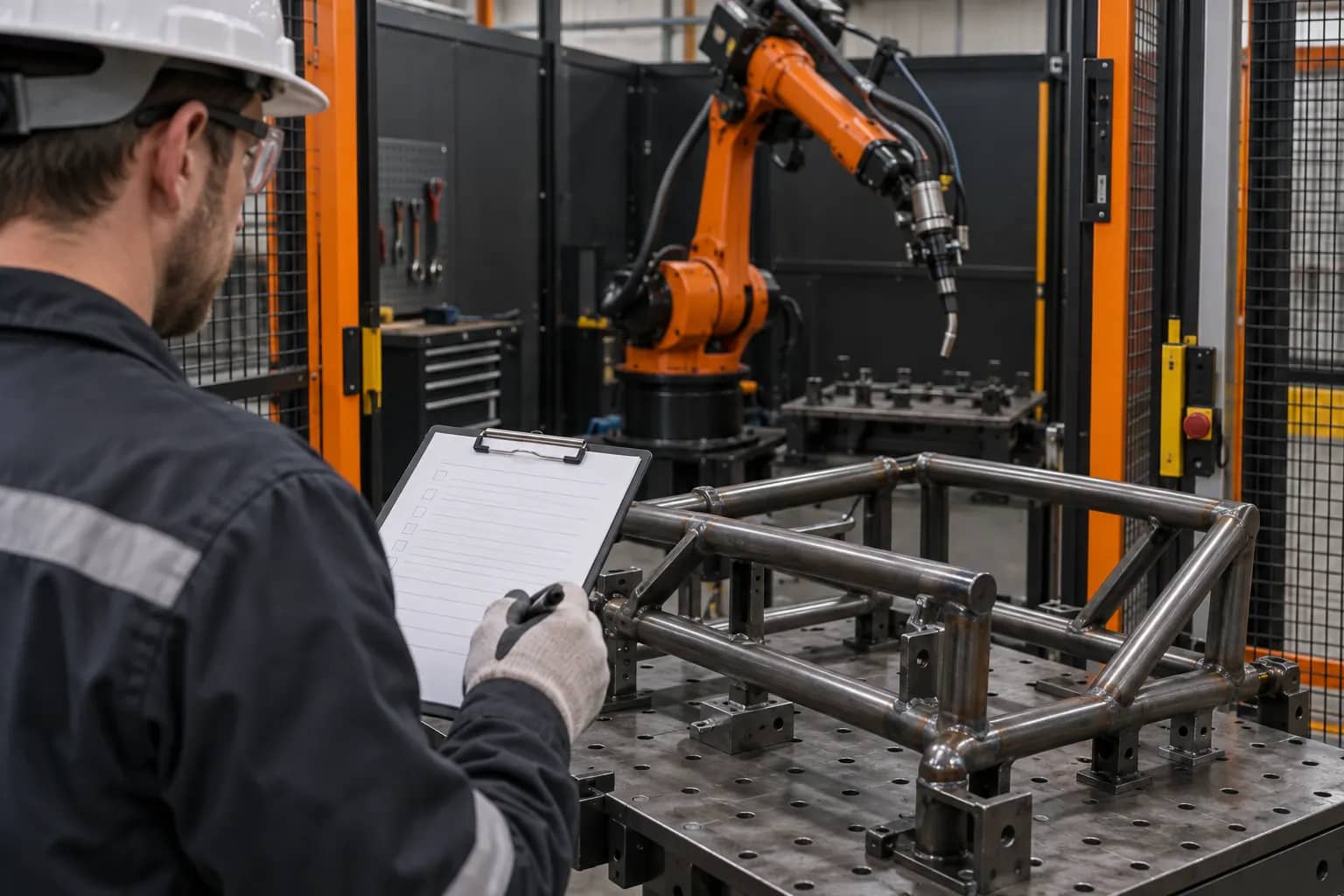
Ask the responsible integrator to demonstrate the agreed guarded-access, emergency-stop, interlock, restart and fault-reset behavior under the project's safety plan. Include controlled tests for missing or misloaded parts, arc interruption, clamp fault and loss of a required signal where applicable. The expected safe state, restart authority and post-fault part inspection must be documented; a successful restart alone is not enough.
Safety validation belongs to competent parties under the applicable risk assessment and standards. FAT observations cannot be called a blanket safety certification. Capture software/parameter backups, alarm logs, operator and maintenance instructions, spare-parts list and the procedure for restoring the released version before shipment.
- Safety-function test record and unresolved safety findings
- Fault/recovery steps with operator permissions
- Backup and restore proof for released versions
FAT release and exception flow
Protocol and samples
Run and inspect
Pass / fail / not run
Owner, fix and re-test
Signed shipment decision

Turn defects into a controlled shipment decision
Use four distinct outcomes: pass with evidence; fail requiring correction and re-test; not run with reason and owner; or a specifically agreed site-only test. A conditional shipment is possible only when buyer and supplier explicitly accept the open items, mitigation, owner, due date and SAT hold point. A failed weld or safety function should not become a pass because a machine must leave the factory.
The FAT record should contain dated results, sample IDs, photos or measurements where permitted, program/version identifiers, a deviation log, re-test evidence and named signatories. The signed release authorizes only the agreed pre-shipment scope. SAT then verifies installation, utilities, site interfaces, operator training and agreed production performance at the destination. Request the matrix as part of the quote rather than negotiating acceptance after fabrication.
- No silent waivers: every deviation has an owner and written disposition.
- Re-test affected functions after software or fixture changes.
- Keep FAT release and SAT completion as separate records.
Further reading: Toyota Automated Logistics — factory acceptance test ↗
Robotic welding FAT witness matrix
Use each row with a project-specific limit, sample count, result (pass/fail/not run/site-only), record ID and signer. This is a planning template—not a claim that any TubeFrame cell has passed.
Copy the rows into your RFQ or investment worksheet.
| Test gate | Agree before FAT | Hold / exception trigger | Retain as evidence |
|---|---|---|---|
| Configuration | Robot, source, fixture, positioner and software versions | Unapproved substitution or mismatch | As-built list and version capture |
| Sample parts | Part IDs, revisions, nominal/boundary fit-up | Unrepresentative or undocumented samples | Sample register and incoming measurements |
| Weld quality | Weld list, method, acceptance criteria and sample count | Failed inspection or undefined limit | Inspection report tied to part ID |
| Frame dimensions | Critical datum and post-release dimensions | Passes in clamp but fails after cooling | Dimensional report and gauge ID |
| Full-cell cycle | Load-to-accepted-part sequence and repeat count | Only arc time shown or target missed | Timed run log with stoppages |
| Changeover | Variants, settings and first-piece release | Wrong program or ambiguous setup | Witnessed change and first-piece record |
| Safety functions | Guard, interlock, stop, reset and validation owner | Unsafe or undocumented response | Risk-assessment-linked test record |
| Fault recovery | Misload, arc/clamp fault and restart rules | Uncontrolled restart or unknown weld status | Fault log and recovery observation |
| Controls/I-O | Required signals and site-only interfaces | Missing signal or unassigned SAT item | I/O test and interface register |
| Documentation | Programs, backups, manuals, spares and training | No restorable released version | Document index and restore proof |
| Open items | Severity, owner, due date, mitigation and re-test | Unapproved waiver or failed critical test | Deviation log with closure evidence |
| Shipment decision | Authorized signers and FAT/SAT split | No signed release or open hold | Dated FAT report and shipment authorization |
Frequently asked questions
What is the difference between FAT and SAT?
FAT witnesses the agreed pre-shipment scope at the supplier's facility. SAT verifies installation and site-dependent interfaces and performance after delivery. The protocol must identify which requirement belongs to each stage.
How many sample welds should FAT include?
There is no universal count for every cell. Buyer and supplier must agree representative variants, boundary conditions, acceptance method and repeat count in the project specification before testing.
Can we ship with open FAT items?
Only if the authorized buyer and supplier explicitly agree the item's risk, mitigation, owner, due date and re-test or SAT hold point. A failed critical safety or weld requirement must not be silently marked as passed.
Does a passed FAT certify robot-cell safety?
No. FAT records evidence against an agreed protocol. Applicable risk assessment, safety validation, technical documentation and regulatory obligations remain separate responsibilities.
Original sources and limits
Put acceptance terms in the RFQ
Share part drawings, weld and quality criteria, target good output, safety and site interfaces. Ask for a versioned FAT/SAT protocol, witness rights and defect-closure rule before ordering.
Request a welding-cell quote ↗