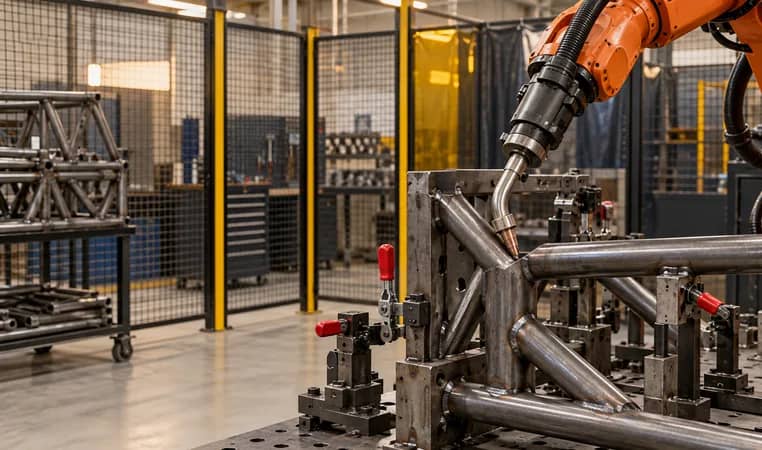
Five inputs that define usable torch access
Capture these with the intended joint, fixture concept and representative part condition—not only a nominal model.
- Joint and process
- Joint type, sequence and permitted orientations.
- Physical envelope
- Neck, nozzle, mount, wrist, cables, clamps and part.
- Variation
- Tack-up, locating and distortion that change the path.
- Motion and recovery
- Approach, weld, retract, collision response and restart.
- Service boundary
- Consumables, cleaning, cable inspection and change control.
Do not approve a fixture from a torch-centerline sketch alone. Validate the full moving assembly through approach, welding, retract, service and the defined exception path.
Start with the joint, then set the torch envelope
The question is not whether the wire reaches one point. The chosen torch must approach, weld and leave every required joint while retaining the planned process conditions. Fronius documents the torch as a combined neck, drive, collision protection and hosepack assembly, so access depends on that real assembly—not an abstract TCP.
- Review the complete moving assembly.
- Keep the defined part and fixture revision in the record.
Further reading: Fronius — Robacta Drive CMT-PAP G operating instructions ↗
Torch-access review: four layers that must agree
Joint and orientation define the objective.
Torch, wrist, fixture and part form a moving envelope.
Collision, stop and recovery need named behavior.
Consumables and inspection must remain reachable.
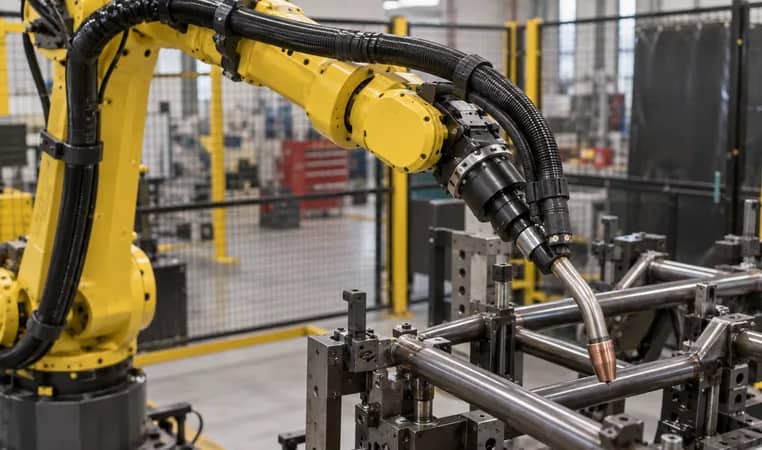
Make the fixture support access
Every locator, toggle and support occupies space that the torch, wrist or cable may need. Review clamps open, closed and in service. Make each interference an owned decision: revise the clamp, locating strategy, torch assembly, robot pose or weld sequence.
- Review the complete moving assembly.
- Keep the defined part and fixture revision in the record.
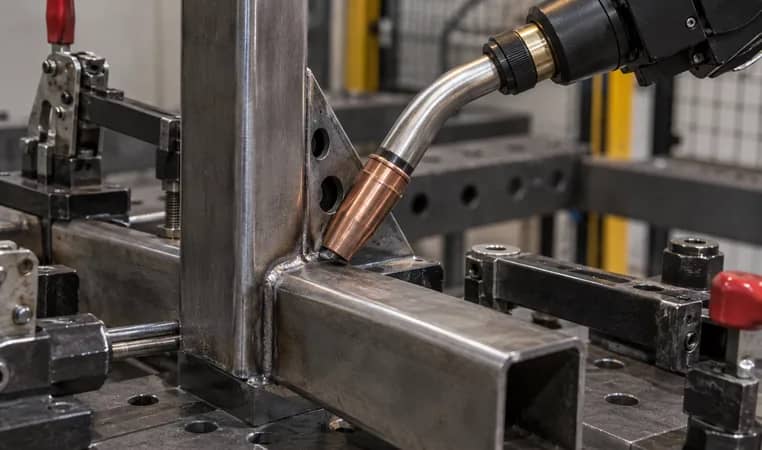
Route cables and collision protection as moving interfaces
Cable routing has to survive all axes and service moves without pinch, snag or fixture contact. Kemppi’s installation sequence connects collision sensor, cable pack and torch as one system. A collision device defines a response; it does not prove clearance.
- Review the complete moving assembly.
- Keep the defined part and fixture revision in the record.
Further reading: Kemppi — GX-ROBOT hollow-wrist installation ↗ · Kemppi — GX-ROBOT equipment description ↗ · Kemppi — A7 MIG Welder collision sensor ↗
From weld joint to released access evidence
Joint, sequence and process
Torch, cables, clamps and variation
Approach, weld, retract and service
Interference and exception
Witnessed record
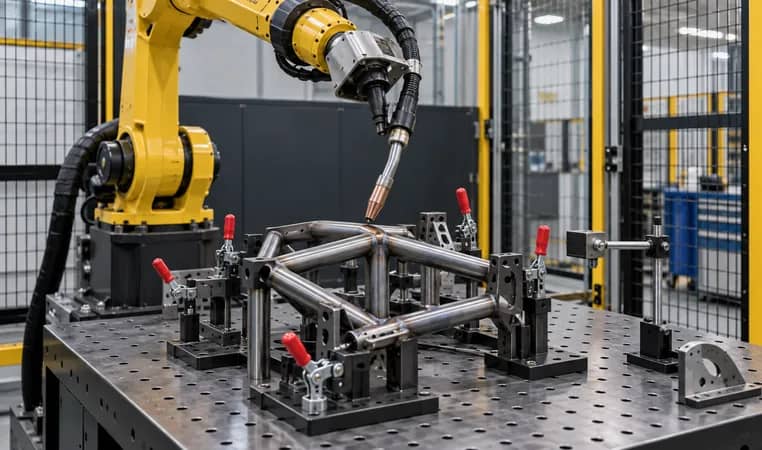
Release access with witnessed evidence
Keep a record for each joint, fixture revision, torch assembly, path, service position and exception response. Witness dry paths and representative parts, then reopen the affected joint when a drawing, clamp, torch, cable route or sequence changes.
- Review the complete moving assembly.
- Keep the defined part and fixture revision in the record.
Further reading: Kemppi — GX-ROBOT hollow-wrist installation ↗
Robot welding torch access checklist
Use these rows in a fixture or cell review. Evidence should be project-specific.
Copy the rows into your RFQ or investment worksheet.
| Review item | Define | Do not assume | Evidence |
|---|---|---|---|
| Joint family | Geometry, sequence and intended process | One pose represents every joint | Drawing revision and weld map |
| Torch assembly | Neck, nozzle, mount and service condition | The wire centerline is the full envelope | Assembly model or physical check |
| Cable package | Routing, bend path and axis travel | Static slack proves motion clearance | Axis-range motion trial |
| Fixture | Clamps open, closed and in service | Only closed clamps affect access | Fixture-state review |
| Part variation | Tack-up, location and distortion envelope | Nominal CAD is production geometry | Representative-part trial |
| Approach | Entry and exit poses for every joint | A weld pose is enough | Dry-path witness |
| Collision | Signal, stop, inspection and reset | A collision mount creates safe clearance | Defined exception test |
| Service | Cleaning, consumables and cable inspection | Service is outside the layout scope | Service-position review |
| Change control | Events that re-open the review | A new clamp or torch is cosmetic | Revision-controlled record |
| Acceptance | Witnessed path and exception evidence | One successful dry cycle proves all | Signed access checklist |
Frequently asked questions
What is robot welding torch access?
It is the ability of the complete torch assembly—not only the wire point—to approach, weld and leave a joint while clearing fixtures, parts, robot motion and cable routing.
Can a fixture be approved from a reach study?
A reach study is useful but incomplete. Check the neck, nozzle, collision mount, cable package, clamps, variation, approach, retract and service states.
Does a collision sensor solve an access conflict?
No. It can provide a defined response to contact, but it does not make an obstructed path usable. Control the interference and define inspection and restart behavior.
What should I send for an access review?
Send the part drawing and weld map, fixture concept, samples or photos, process and sequence, robot package preference, variation and service constraints.
Original sources and project boundary
Turn difficult weld access into a reviewable cell scope
Share the part drawing, weld map, fixture concept, process requirement and preferred robot package. We can help organize the torch, fixture, cable and validation inputs required for a project-specific welding-cell discussion.
Discuss welding-cell access ↗