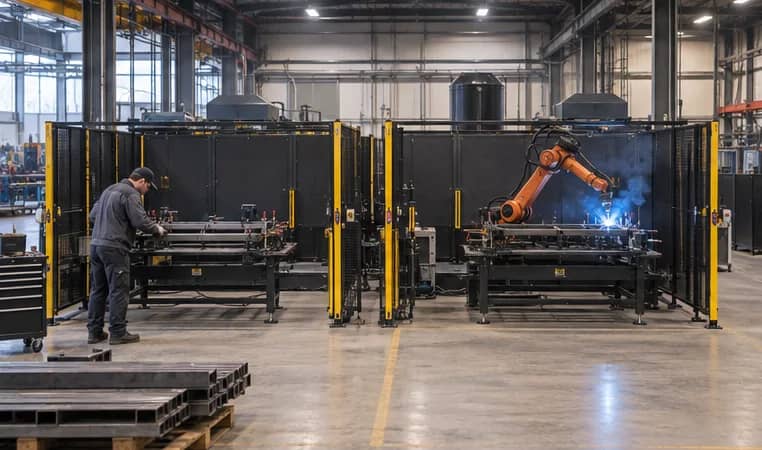
A five-input station pitch model
Time one accepted part in the intended mix. Keep the same quality and staffing assumptions for both options. Minutes per part are the unit throughout.
- R — robot occupancy
- Approach, positioner motions, welding, sensing and robot-side torch cleaning that block the next part.
- H — handling
- Unload, present, locate, clamp and verify the next part, including operator travel.
- O — usable overlap
- The share of min(R,H) truly done in parallel; 0 means none, 1 means complete overlap.
- X — exchange
- Index, shuttle, zone reset or robot travel needed to hand over stations.
- C — common time
- Inspection, reset or other unavoidable work outside the overlapping interval.
Single pitch = R + H + C. Dual pitch = R + H − O × min(R,H) + X + C. Divide 60 by pitch for a theoretical parts/hour ceiling, then apply demonstrated good-part yield, availability and demand separately. A nonpositive saving is a stop sign, not a station recommendation.
Time the entire cycle, then locate the bottleneck
Arc-on minutes alone omit robot travel, sensing, positioner moves, torch service, handling, inspection and recovery. Capture a representative part family and a demanding variant with an agreed start/end event: one accepted part out, the next accepted part out. Distinguish robot-occupied, operator-occupied and shared activities on a time line.
A dual station changes the schedule, not the weld physics. Fronius describes a cell used as one station for large work or as two stations for parallel setup and welding; Miller describes independent stations that allow tooling changeover opposite ongoing welding. Neither proves how much overlap your part, crew and safety design will actually permit.
- Record a median and a spread, not one best run.
- Mark the constrained resource: robot, operator, fixture, upstream parts or downstream inspection.
- Count only good units the plant can use; theoretical pitch is not contracted output.
Further reading: Fronius — CWC-S and CWC-D station configurations ↗ · Miller — PA2200SS product sheet (2022-02) ↗
What the second station can and cannot change
One fixture area; robot and handling generally wait on each other.
Load and unload the inactive zone while the robot welds the other, subject to safeguarding.
More tooling and exchange time with little or no throughput benefit.
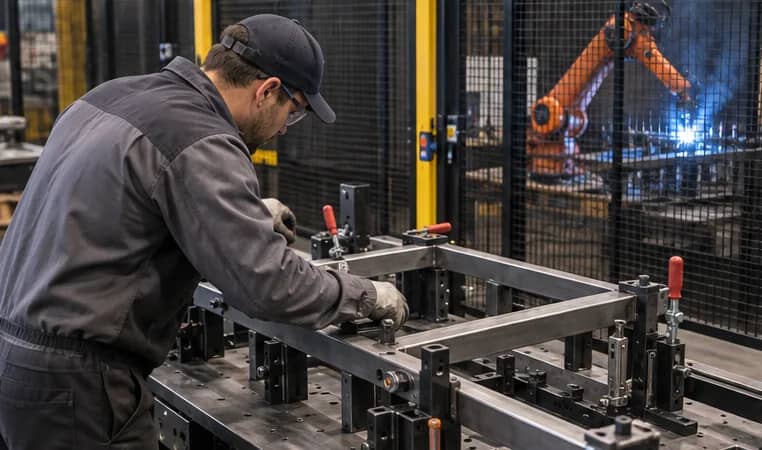
Worked comparison: example assumptions, not a forecast
Assume R = 6.0 minutes, H = 4.0, X = 0.7 and C = 0.3. One station takes 6 + 4 + 0.3 = 10.3 minutes per accepted-part opportunity, or 5.83 theoretical parts/hour. With full handling overlap (O = 1), two stations take 6 + 4 − 4 + 0.7 + 0.3 = 7.0 minutes, or 8.57 theoretical parts/hour. These figures omit scrap, planned breaks, failures, part mix and demand.
If only 50% of handling overlaps, dual pitch rises to 9.0 minutes and the theoretical advantage shrinks to 14.4%. At zero overlap, dual pitch is 11.0 minutes—worse than the single station. Recalculate with measured time distributions, not a brochure's arc time. One operator cannot safely load a second zone unless the risk assessment and cell controls support independent access.
- The second station is valuable only when H is substantial, overlap is real and the exchange penalty is controlled.
- At R = 6, H = 1, X = 0.7 and C = 0.3 with full overlap, pitch changes from 7.3 to 7.0 minutes: a small gain before capital and floor costs.
- Do not multiply hourly ceilings by shift length without availability, changeovers, yield and demand limits.
Further reading: Fronius — CWC-S and CWC-D station configurations ↗
Compare changeovers, people, space and downtime
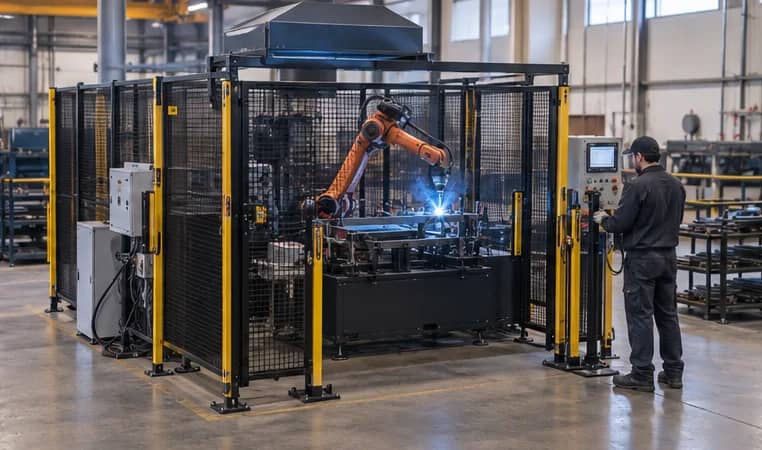
Independent nests may let a high-mix line prepare another fixture while one variant welds, as Miller's PA2200SS sheet describes for its product. Yet a second fixture adds locating, storage, program-selection and first-piece control. A large or awkward workpiece may consume both zones; a poorly placed divider may remove access or force an unsafe handling path.
Record who staffs the loading side, the exact safeguarding behavior when a gate opens, and whether a fault at one station stops the whole cell. Draw the footprint with material carts, positioner sweep, fume equipment, maintenance door swing and future access. Compare the incremental investment as scoped equipment and operating cost, not a generic price or promised payback; the companion cost and ROI guides handle those questions.
- Changeover: fixture swap, program verification and first-good-part time.
- Labor: one person's safe workload versus robot pace and inspection demand.
- Resilience: fault isolation, spare fixture route and restart evidence.
- Space: guarded envelope plus staging, service and pedestrian flow.
Further reading: Miller — IFH Group cell application (2026-07-26) ↗ · Miller — PA2200SS product sheet (2022-02) ↗
Station-choice evidence flow
R, H, X and C by part
Parallel tasks and zone states
Pitch and sensitivity
Safety, space, labor and demand
Trial and acceptance basis
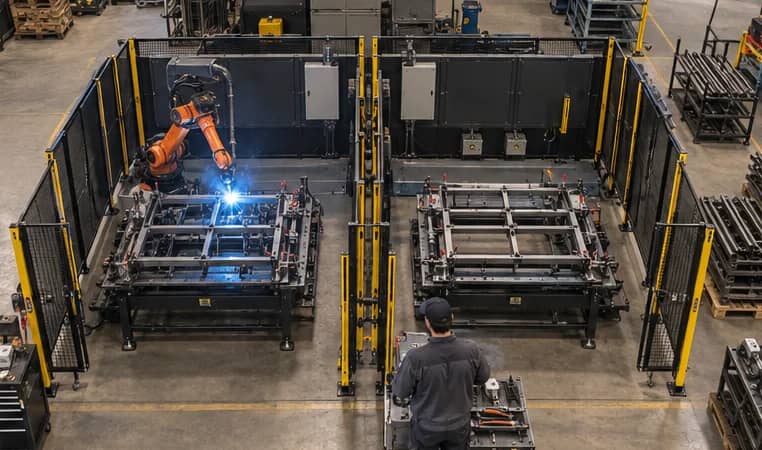
Release a station concept only with measured evidence
Use a time-study sheet for R, H, X and C across representative parts. Ask the integrator to show the parallel-operation sequence, zone states, reachable welds, fixture changeover, fault recovery and full-cell cycle on the actual workpiece. Assign an owner to prove safety functions and to define the FAT/SAT boundary.
Send the drawings, annual part mix, handling method, target good output, shift pattern, floor plan and utilities to a supplier. Request a one- versus two-station concept with included/excluded tooling, staffing assumptions, footprint and acceptance tests. For the process overview see robotic welding; for commercial scope see the welding-cell cost guide; for economic sensitivity use the ROI guide.
- Keep the single-station option as the baseline, not a straw man.
- Reject any rate comparison that changes part family, quality rule or staffing without disclosure.
- Confirm the chosen concept at FAT and on site against agreed sample parts and full-cycle events.
Further reading: Yaskawa SRCI — safety setup ↗
Recalculate the station choice
All times below are example assumptions in minutes per accepted-part opportunity. Replace them with measured site data. The model shows theoretical pitch only, not a quote, throughput guarantee or ROI.
Copy the rows into your RFQ or investment worksheet.
| Assumed case | Single pitch / ceiling | Dual pitch / ceiling | What changes the decision |
|---|---|---|---|
| Base: R6, H4, O100%, X0.7, C0.3 | 10.3 min / 5.83 per hour | 7.0 min / 8.57 per hour | 4.0 min handling overlaps; verify safe zone independence. |
| Partial overlap: O50% | 10.3 min / 5.83 per hour | 9.0 min / 6.67 per hour | Only 2.0 min overlaps; benefit falls sharply. |
| No overlap: O0% | 10.3 min / 5.83 per hour | 11.0 min / 5.45 per hour | Exchange adds time without hiding handling. |
| Short handling: R6, H1, O100% | 7.3 min / 8.22 per hour | 7.0 min / 8.57 per hour | Small gain may not justify tooling and space. |
| Exchange rises to 2.0 min | 10.3 min / 5.83 per hour | 8.3 min / 7.23 per hour | Index or reset erodes saved time. |
| Release check | Measured full-cycle baseline | Measured parallel run and quality | Apply good-part yield, downtime, mix and actual demand. |
Frequently asked questions
Is a dual-station welding cell always faster?
No. It saves only handling that genuinely overlaps robot work. Exchange, shared tasks, changeover, downtime, staffing and part demand can erase the theoretical gain.
Should I compare arc-on time or full cycle?
Use the time from one accepted part to the next. Include robot travel, positioner moves, loading, clamping, inspection, torch service and station exchange as applicable.
Can one operator load while the robot welds?
Only when the engineered zones, safeguarding, access controls and task-based risk assessment permit it. The layout and staffing plan must be validated for the actual cell.
Does the example 8.57 parts/hour apply to TubeFrame cells?
No. It is a theoretical result from explicit teaching assumptions, before yield, availability, mix and demand. A project needs measured parts and acceptance criteria.
Original references
Compare station concepts with your real parts
Send representative drawings, measured handling and weld cycles, part mix, target good output, staffing and available floor area. Request a one- versus two-station scope with an evidence plan.
Discuss a welding-cell concept ↗